
There are many economics systems that have been proposed and tried throughout history. Included among these are Feudalism, Socialism, Communism, and Capitalism. All of these economic systems exist in the world even today. Places that use Capitalism are doing much better than those that are using other systems. The reason is that Capitalism motivates people to do good and think of the needs of others, where the other systems either provide little incentive at all or encourage greed and selfishness.
Of all of the financial systems created, Capitalism has done the most for the poor and it has created the middle class. It is fundamentally good. More than that, it rewards those who do good for others. In this article we’ll describe what capitalism is and how it works. We’ll also show why it works so well and brings blessings to those who are willing to help others.
(Note, if you click on a link in this post and buy something from Amazon (even if you buy something different from where the link takes you), The Small Investor will receive a small commission from your purchase. This costs you nothing extra and is the way that we at The Small Investor are repaid for our hard work, bringing you this great content. It is a win-win for both of us since it keeps great advice coming to you (for free) and helps put food on the table for us. If you don’t want to buy something from Amazon or buy a book, how about at least telling your friends and family about our website as a great place to learn about investing and personal finance. Thanks!)
Imagine if everyone were farmers
Picture a world where everyone had a small farm/homestead. Each family grew the crops they needed, had livestock to provide milk, eggs, and meat, and had things like a woodshop and a blacksmith shop to produce tools and other items. Each family was self-sufficient and had enough children to take care of the work needed. Essentially each family would be a commune within a large set of families that were also communes. Each family is focused on his/her own family and each family works with their members to provide all that is needed. They have large pantries, meat storage sheds, and root cellars to store up food for winter, which they work hard all summer through the fall to fill each year.
This system would work well for many people. The society wouldn’t produce much in terms of science or art because people would be busy just trying to survive. Perhaps an especially large family would be able to sustain a member or two who did something besides the daily chores of running the farm so we could see some artists or inventors, but most people would be occupied from dawn until late evening just doing what was needed to survive.

My new mini-book is available for just $2.99. Order your copy today!
Meet Lazy Larry
Let’s say now that there is a guy who is kind of lazy. Let’s call him Lazy Larry. Lazy Larry doesn’t want to do that work of picking, preparing, and storing food. He wants to enjoy his late summer and do a lot of swimming down at the local water hole. But Larry still needs to eat and have shelter, so he needs to come up with a plan if he wants to enjoy life.
Lazy Larry has an idea. He sees that most of the homes have a lot of trees where he lives and they all drop a lot of leaves in the fall. Larry has a rake and a plan:
Larry goes up to each home on his block and offers to rake and bag the leaves on their street if they will give him enough food, ready for storage, to eat for about two weeks. In providing him food they can even go to his place and pick what is in his garden if they will put it in jars and boxes for him. The homeowners are busy preparing food for the winter and would rather not need to rake and bag leaves. But they want to have nice looking lawns. (Larry says that their homes would look a lot nicer if they didn’t have bunch of leaves rotting in the yard all winter.) Larry’s offer seems attractive.
About 15 homes agree and Larry gets to work. He finds that it takes him about a day, about 8 hours, to clear a lawn of leaves, bag them up, and take them back to his place for for each home. He throws the leaves in a big pile in the back when he gets home. Once he is done raking over a period of about two weeks, he has 15 x 2 = 30 weeks worth of food in his pantry and root cellar. That’s plenty to get him through the winter and a lot of the spring into the summer. Lazy Larry is happy. Homeowners are happy.
Larry has discovered Capitalism. Rather than do everything he needed to sustain himself and take care of all of his needs directly, he did something he was fairly good at and that he liked doing better for other people. Because the people he served wanted the work done, they agreed to give him some food, ready for storage for the winter, which he needed. Because he took care of the leaves, they had extra time to prepare food for storage. For them, preparing a little extra food was easier than stopping what they were doing to go rake leaves. Both Larry and the homeowners could be more efficient doing one task than they would be doing several tasks, saving them both time.

SmallIvy Book of Investing: Book 1: Investing to Become Wealthy

Larry steps up his game
Larry is still lazy. He is happy to not need to prepare food for winter storage, but he still needs to get his garden going in early spring and tend it through the start of the summer since he runs out of stored food around May. Larry needs a bigger plan. He develops a new one:
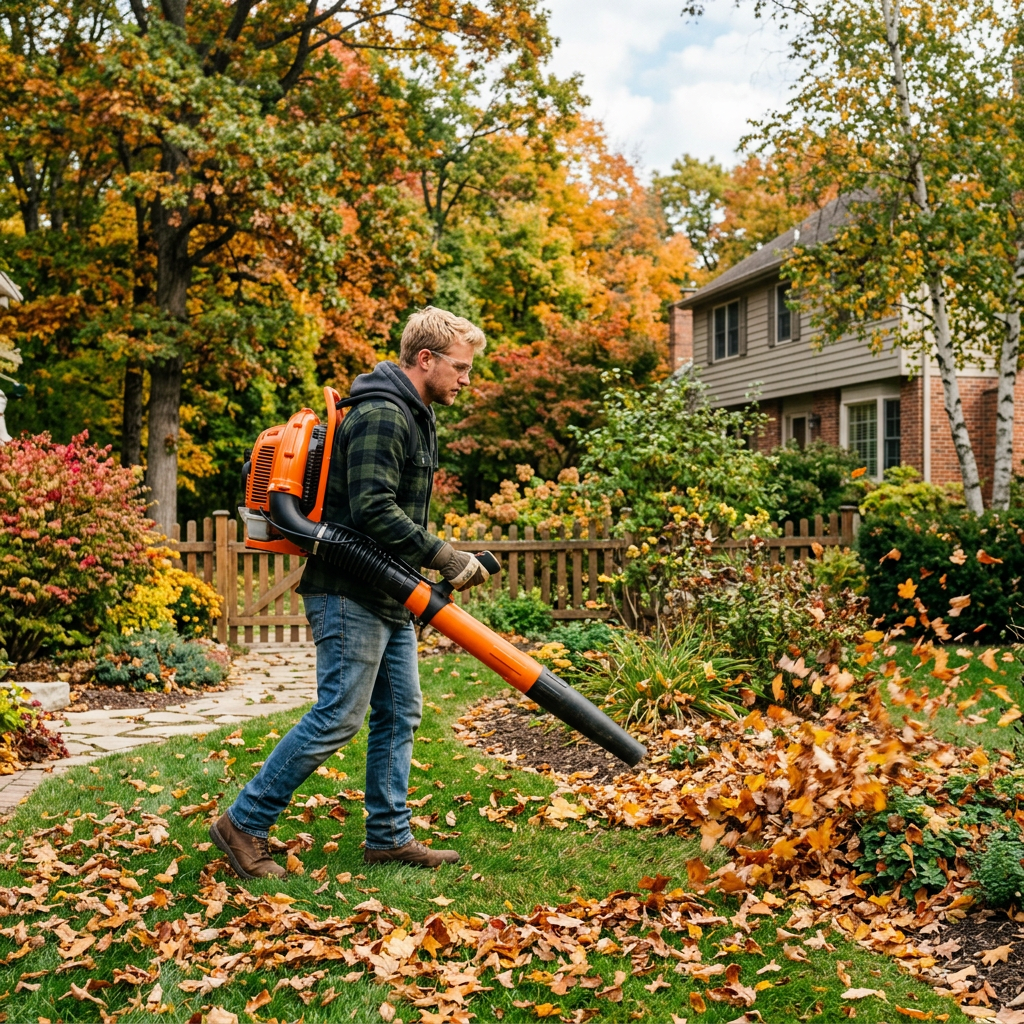
Larry has heard that he can buy a contraption from a far away land (where everyone is not farmers) called a “leaf blower.” With this device, Larry could blow leaves instead of raking, which would both be faster and easier than doing all of the raking. Larry figures that if he can get one of those, he could do 2 to 3 homes per day instead of just one in the fall. If he can clear more homes of leaves, he can get more food. This will mean that he might be able to make it through the whole year without growing any food himself. That sounds great to Lazy Larry.
Larry puts in some extra crops as he starts his garden that year. Then as he gets into July, he trades some of the extra vegetables he grows to a family in that distant land for a leaf blower. He learns how to work it and maintain it, then he is ready to expand his business.
He also discovers that the leaves he collected the fall before have decayed and created rich compost, great for growing crops. He asks around and finds that people will trade him compost for things that he needs like lamp oil and tools that he needs. He has opened up a side business of selling compost without that even being part of the plan.

Larry wants to attract more customers, so he lowers the amount of food that must be traded for a lawn cleared of leaves. Because he can work more efficiently, he can do this and still get more food than he did the previous year. Lowering the price makes more people decide that the service is worth the work to make the extra food and Lazy Larry is able to sign up and provide his leaf service 30 houses this year. He is still able to do all of the jobs over about a 2-week period and is able now to get enough food to feed himself for the full year. He even gets a little extra food that he is able to trade to a guy for gasoline for his leaf blower.
Notice what has happened here:
- Larry was able to satisfy his yearly need for food in far less time than it would take for him to plant, tend, pick, prepare, and store for himself.
- By specializing in leaf removal, Larry is able to buy and maintain a device (the leaf blower) that makes him a lot more efficient, making it possible to service more houses in the same amount of time, increasing how much food he earns per hour of work. The homeowners would not have had the time to trade food to buy and maintain such a device themselves to only clear their own leaves. The tool costs and takes too much effort when they only need to use it for an hour or two per year.
- Larry was able to expand into a new area — compost — with little additional effort since he was creating it anyway by collecting and storing the leaves.
So, what does this have to do with Capitalism?
This is the beauty of Capitalism: By allowing people to specialize because they can trade for things they need, they are able to both buy or make special tools to become more efficient. In addition, they also get better and faster through experience of doing the same tasks regularly.
But they can’t just do anything. They need to find things that people need to have done. In Larry’s case, he found that people wanted to have their leaves rakes to keep their lawns from dying and to make their homes look better. Other people might find that people wanted food for their livestock or fertilizer for their crops. Capitalism forces people to think about the needs of others and try to provide them with what they need. Even Lazy Larry was contributing to society and thinking of the needs of others.
(For ways to increase your free cash flow and use it to build wealth, check out FIREd by Fifty, How to Generate the Cash Flow You Need to Retire Early.)
What about Socialism?
There is nothing stopping people from specializing and trading labor in Socialism. The difference is that the State owns the companies, equipment, buildings, and everything and then directs people on what they produce and doles out the products generated. Wouldn’t this work just as well?
Well, enter Socialist Sam. Sam also decides that he doesn’t want to work as hard and wants to take his late summers off to go swimming. Sam gets together with 10 of the other families and makes his own proposal:
“How about we form a collective and all work together for everyone. We’ll decide on which people to do which jobs based on their ability and give them the tools and resources to do those jobs. We’ll share land and tools, letting whoever is growing food use those since they are the ones producing food for everyone. We’ll then have other specialists work together to harvest the food and prepare it, then we’ll give it out based on what people need. This will be better,” Sam says, “because even people who aren’t able to farm as well will get all that they need. Your ability to eat will no longer be based on what you are able to do based on your natural abilities. We won’t see people getting more just because they have better land or are better at farming. That will be much more fair and just”
The families decide to go with this idea. This sounds good to them and better than each needing to do everything. Sam appoints himself as the person who manages everything — it was a hard job, but it was the least he could do. The families get to work and start planting crops and tending to them.
But some of the people discover that, because there were other people working, they could still eat without working as hard. They found excuses to take breaks and called in sick a lot. They secretly talked among themselves how those who were out in the fields all day, working hard, were suckers. It was better to sit and enjoy yourself, letting the others toil if that was what they wanted to do.
Sam was a poor manager. He didn’t do a good job of scheduling people, scheduling too many people for some tasks and forgetting abut others. This, combined with the lazy people who worked little, caused production of food to decline. Sam also didn’t have all of the harvested grain taken into barns before a big storm, deciding instead it was a good day to have a picnic to lift the spirits of the people who were working and who were upset with him. As a result, a lot of the grain was spoiled. When harvest time came and went, there was a shortage in what was gathered and prepared.
Despite being short, Sam started to dole out the food that he had. Luckily for him, he was in control and he could make sure that he would not go hungry. He first took all that he needed, plus a bit more (he figured he could trade it). He then gave out roughly equal to everyone, except a few people he liked or wanted to have influence over to whom he gave more.
He also found that some people would do favors for him in exchange for more food, so those he rewarded, cutting what he gave others who did not do him favors. He found that during shortages (caused by his incompetence), people were even more willing to do him favors for food since otherwise they would be hungry. He learned that this was to his advantage and gave him power, so he purposely did things to keep production low in addition to general incompetence.
Sam’s story shows the issue with Socialism. Having the State manage things tends to cause mismanagement since people are appointed due to connections rather than based on skills and competence. Once they are in power they are difficult to remove since anyone who speaks up can see his resources cut off. People are also incentivized to work less since they get the same share regardless of how much they produce. This results in less being produced. It becomes a game of seeing how little you can contribute and how much you can get. Finally, the power a few people have because they control the distribution and the jobs leads to corruption and abuse.
Capitalism, which rewards production and meeting the needs of others. is a far better system. More is produced, the right things are produced, and people have an incentive to work and do things for others. There tends to be so much excess left over that the needs of those who cannot care for themselves can be covered easily.
To ask a question, email smallivy@smallivy.com or leave the question in a comment.
Disclaimer: This blog is not meant to give financial planning advice, it gives information on a specific investment strategy and picking stocks. It is not a solicitation to buy or sell stocks or any security. Financial planning advice should be sought from a certified financial planner, which the author is not. All investments involve risk and the reader as urged to consider risks carefully and seek the advice of experts if needed before investing.


